Motorcycles
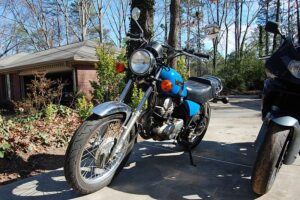
I’ve been learning to ride a motorcycle.
Now, on one level, the essential skills of staying upright and cornering nearly everyone possesses, from riding a bicycle. The basic geometry and dynamics are the same, and so is the muscle memory needed to ride in a straight line, enter a curve, and exit again. If you can do it with pedal power, you can do it with an internal combustion engine.
To ride a motorcycle skillfully and safely still requires training and practice. Starting, stopping, up- and down-shifting, lane positioning, etc., etc., all involve coordination and knowledge that should not be left to intuition and improvisation. You can profit from the experience of others. And if you are so inclined, the study of motorcycle kinematics can be interesting in its own right, and can help you progress in your skills.
But the thing I find truly sublime is the natural facility of the human body and brain to become one with a two-wheeled vehicle. Learning to stay upright on two wheels without even about it comes much more quickly, and perhaps even more naturally, than learning to walk. And once you learn you never forget.
This is only partly down to the nearly infinite plasticity of the human brain, particularly a young one. There are many skills that rely on much simpler physics, yet take much longer to learn. Playing a piano, for instance, is the physics of levers. But the peculiar felicity of the modern two-wheeled vehicle rests on some very specific features.
For example, caster. The steering axis, around which the handlebars turn, is not exactly vertical but at a raking angle. This puts the point where the front wheel contacts the ground somewhat behind the steering axis, so that the steering tends to straighten itself if perturbed by the road. Perhaps more importantly, it also causes the front wheel to turn in the same direction the vehicle leans, causing the vehicle itself to turn and tending to balance the lean with centrifugal force, so you don’t fall over.
Cool.
So you can enter a turn simply by leaning into it, and exit by leaning away from it. And the amount of lean needed is nearly imperceptible, due to the relatively high center of gravity. You can also do these things (enter or leave a turn) much more quickly by doing something very counter-intuitive: pushing the steering in the direction opposite to your desired movement.
As it happens, two forces come into play when you push the handlebar. First is a gyroscopic torque from the spinning front wheel. As long as you’re moving forward, this torque acts to lean the vehicle away from the direction you push.
The second force is due to the fact that, when you push on the handlebar, say leftward, the vehicle will start to turn leftward, but the high center of mass (including your body) is “left behind” so to speak. Centrifugal force again. The vehicle leans right, maybe dramatically so, if you push hard enough. With the vehicle leaning right, the caster of the front wheel causes it to steer to the right as well, and you enter a right turn. If you do this on a bicycle, you can watch the track of your front wheel as you perform the maneuver, and you’ll see an initial turn to the left follow by a clearly distinct and persistent turn to the right.
Also pretty cool.
Practicing these different turn entries on a motorcycle was quite revealing, and now I consciously choose the best technique for each situation on the bicycle. Don’t know how I rode it all these years without catching on before.
But there it is. We have created a form of transportation involving the human body that is not just easier, but arguably more “natural”, than walking.




About The Author
