An Inconvenient Truth
I used to think of Oxfam as a charitable organization engaged primarily in laudable work to alleviate global poverty.
I may have been naïve. This month, Oxfam announced their latest report, Climate Equality: A planet for the 99%. In this report, Oxfam accuses wealthy nations not only of not doing enough to address climate change, but of actually making it worse for everyone.
“The richest people, corporations and countries are destroying the world with their huge carbon emissions.”
“In 2019, the super-rich 1% were responsible for as much carbon emissions as the poorest 66% of humanity (5 billion people).”
(Climate Equality: A planet for the 99%)
Now, as a broad statement, it is indisputable that the richest countries are responsible for the majority of CO2 emissions. But it’s also indisputable that wealthy countries are making the greatest strides in reducing those emissions.
Of course, it’s not surprising that the biggest polluters have the potential to do the most pollution reduction. What might surprise you is just how much they have accomplished. CO2 emissions in the US and other wealthy countries have declined for the last ten years. Actually declined.
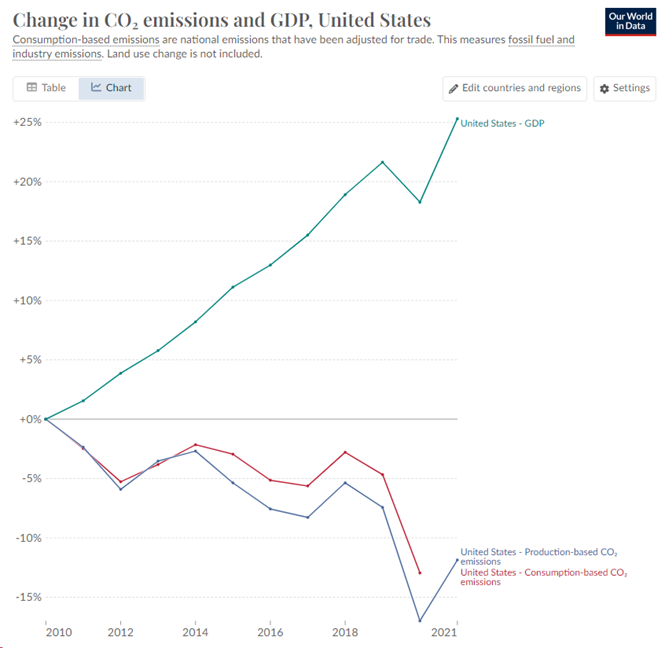
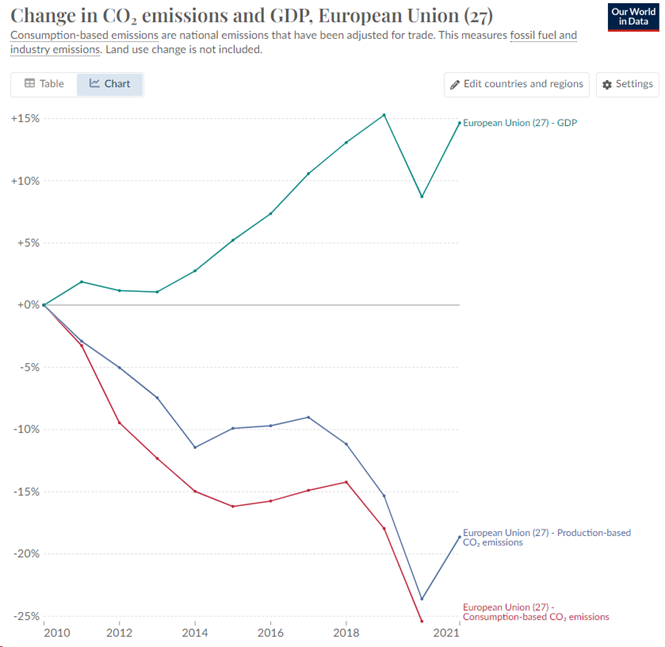
Notice the rising GDP and falling emissions lines. (All charts generated at Our World in Data, here.)
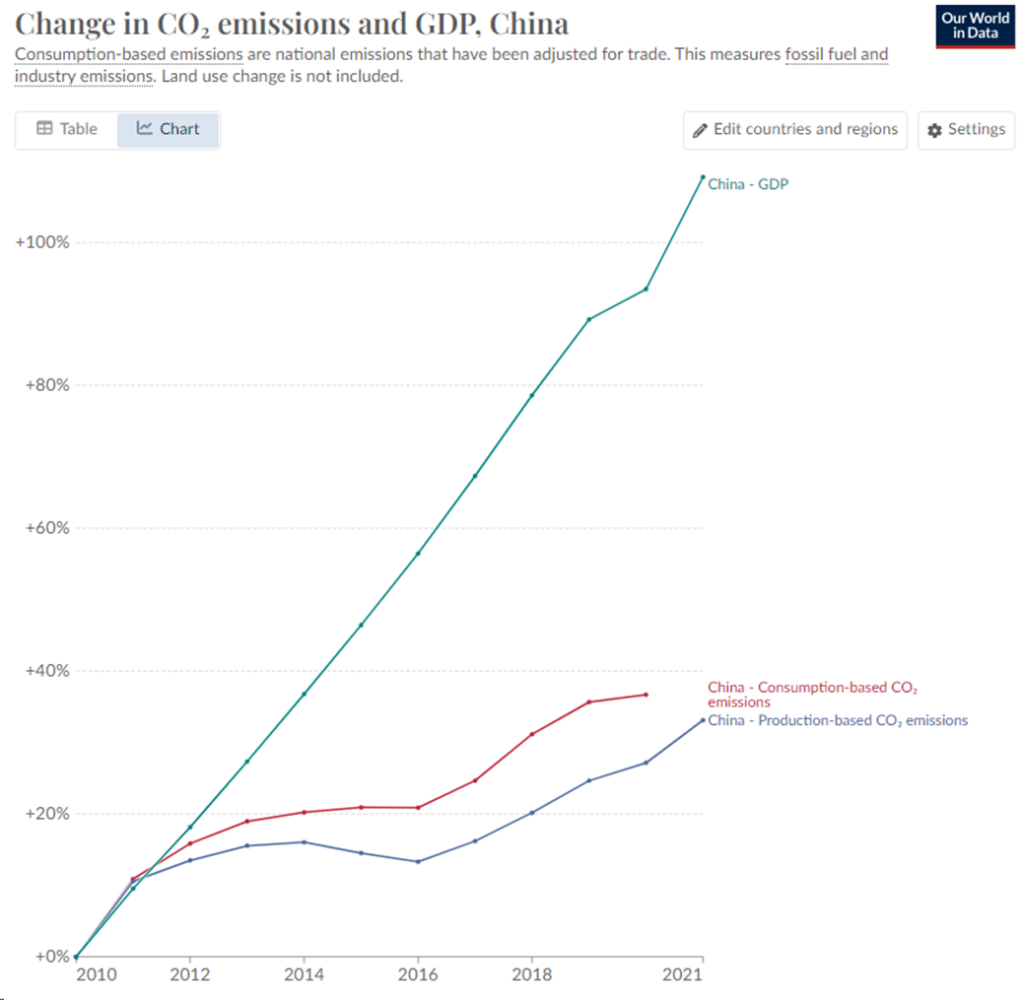
Emissions in China are not falling, but they have really decelerated, despite China’s continued high-growth economy.
In contrast, CO2 emissions by the poorest half of humanity, basically zero by comparison, are rising, because the poor are becoming less poor.
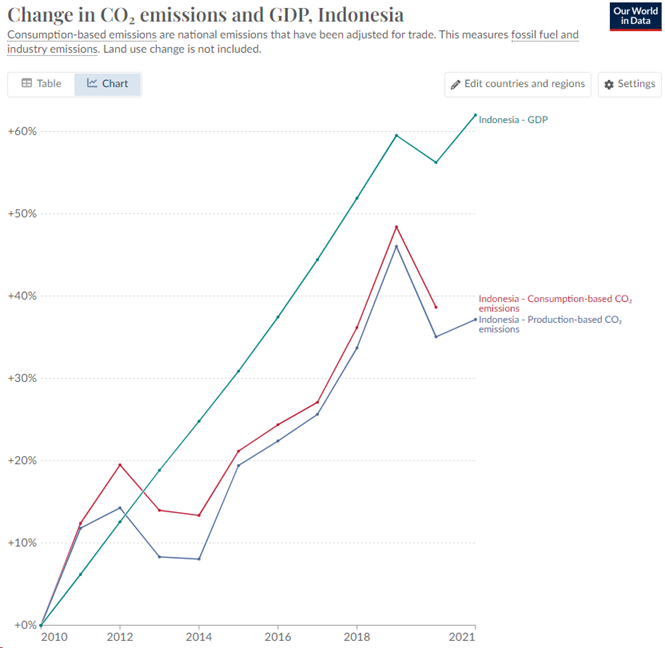
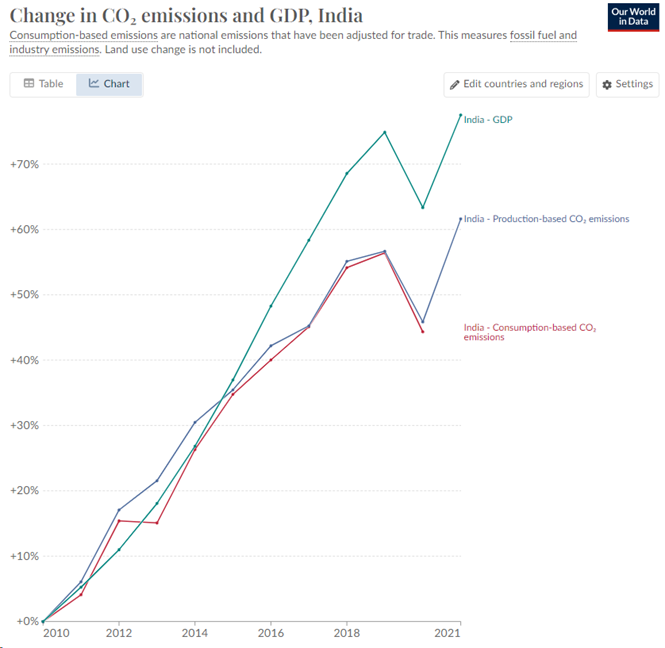
Emissions in countries like India and Indonesia, above, mainly track GDP. In contrast, low-income countries (below) are increasing emissions even faster than GDP.
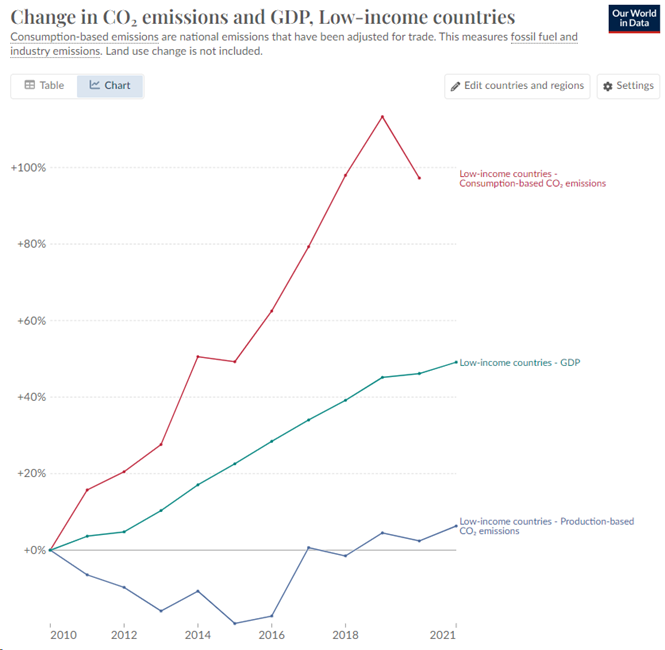
It’s only when you get to countries in the top 10% of income that emissions are falling, and this is mainly due to stupendous (and sometimes controversial) investments in wind farms and solar power.
The developing world does not intend to remain poor. Seven billion people aspire to live the way the other billion do. So it stands to reason that the world as a whole must deploy approximately ten times the rich countries’ investment in clean energy to enable everyone to reach Western standards of living, without destroying the planet. And while it can be argued that better energy efficiency has to be part of the solution, I can’t envision efficiency fundamentally changing the equation.
Of course, no one expects that kind of wealth and income to magically appear in the next few decades. The poor will remain relatively poor. But the question is this: Do we expect them to remain so destitute that their CO2 emissions can be ignored? Or do we expect them to skip fossil fuels and adopt clean technologies right away, as their living standards improve? Because the third alternative is disaster.
This looks to be a very difficult problem. And there is no solution to be found in Oxfam’s report, which mainly goes on about massive taxation to be levied on “the rich” to “build a green and equal world”.
This is wishful thinking, red meat to progressives. But if it’s Oxfam’s idea of a solution, they have removed themselves from the discussion. Not only do they propose that a “green and equal world” can be built on the old pipedream of fleecing the rich, by implication they also propose to compel nearly 8b people to do as they’re told, by spending those cash gifts according to Oxfam’s priorities, not their own.
They are more like a cult waiting for the Second Coming, and Oxfam’s explanation seems to be that it’s “time to make the rich polluters pay”.
Wealthy countries are in fact decoupling GDP from carbon emissions. Low-income countries are in fact on the opposite path. Progressives fixated on billionaires have no more solutions to offer than climate science deniers. One hopes there are people somewhere working on real solutions.
Net-zero by 2050 might be a long shot—although it looks like wealthy countries could come close. But if the rest of the world is to become better off, let alone wealthy, and does so using fossil fuels and legacy technology, net-zero will remain another pipedream. Global warming will smash through 1.5°C and keep going.
To me, this seems to be the real elephant in the room. To borrow a phrase: an Inconvenient Truth.




About The Author

I enjoy your writing style truly loving this web site.
Thank you!
Wouldn’t it stand to reason that the reduction of at least the consumption-based of CO2s in those areas were really due to the pandemic and people driving not nearly as much (to the office/store/school/etc)? Even now, people have not fully returned to the office and commuting, so there will still be a reduction of emissions.
That may be a factor, but the data show an overall decline going back to at least 2010. I use Our World in Data as a reference (they list their sources), and you can see more here: https://ourworldindata.org/grapher/co2-emissions-and-gdp
Thanks!