Carter
Stolen Courage
I am today ordering a freeze on all prices and wages throughout the United States.
– Richard Nixon
These words were addressed to the nation by then-President Nixon in 1971. Inflation was running around 5-6%.
It was a shock. Congress had given him the authority, but no one had expected him to actually use it.
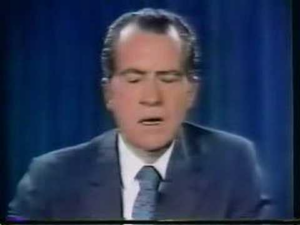
The President assured us that the freeze was temporary, just 90 days at first. But it wasn’t until 1973 that Nixon announced the end:
WASHINGTON, Jan. 11 —President Nixon ended mandatory wage and price controls today — except for those involving food, health care and construction — and replaced them with a system relying mainly on “voluntary cooperation.” He also ended all Federal rent controls. The actions were effective immediately.
In a sweeping revision of the 17‐month‐old stabilization program, the President called on business and labor to support the program voluntarily. But he said he would back it up with the threat of renewed Government wage and price regulation in situations he deemed to be inflationary.
– The New York Times
It didn’t work. By the time he resigned in 1974, inflation had surged to 12%. The federal funds rate had been pushed to 8%.
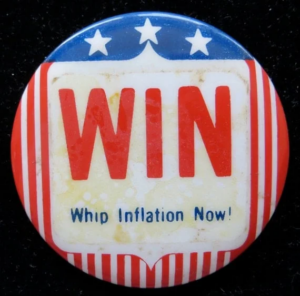
Nixon’s successor, Gerald Ford, tried speeches and buttons with the tagline “WIN” – Whip Inflation Now. Inflation did dip under 5%, after higher interest rates bit, but the dip was temporary.
Inflation was rising again, when Jimmy Carter took office in 1977, and it continued to rise. Carter was well aware of the failures of his predecessors, and after easing out William Miller as chair of the Federal Reserve in a cabinet shuffle, he interviewed Paul Volcker. Volcker made a clear case for aggressively tighter monetary policy, and insisted on no political interference. Carter agreed, and in the summer of 1979 selected him to chair the Federal Reserve, well aware that economic pain would likely follow, and probably in an election year.

By the end of the year, the federal funds rate was nearly 14%. The following year, 1980, was an election year. The country was in recession. Carter was trounced by Ronald Reagan.
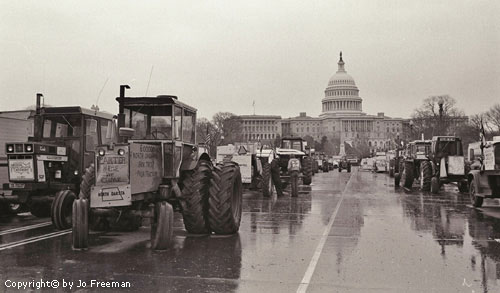
The pain continued. Farmers drove tractors into the Capital to blockade the Federal Reserve building. Someone with a sawed-off shotgun broke in, but was overpowered before anyone was hurt. Builders mailed two-by-fours to the Federal Reserve in protest.
Reagan’s chief of staff James Baker passed along angry presidential demands to Volcker to ease up on interest rates. Legislators and other officials publicly threatened the Fed’s independence.
Carter’s man ignored the threats and stayed his course. Eventually, both the inflation and unemployment rates began to fall. The recession ended, inflation fell below 4% as economic recovery began, and it was Ronald Reagan who took the victory lap, running “Morning in America” commercials during the 1984 campaign and easily winning a second term.
And today it is Reagan, not Carter, who is remembered as the president with the courage to slay the dragon of inflation.
But while in office, Carter had still bigger fish to fry. In the middle of the twentieth century, key transportation industries were closely regulated – tightly managed, actually – by the federal government. Far from objecting, the major players were quite comfortable with what amounted to a guaranteed market and guaranteed profit.
Life was relatively easy for airline and trucking executives.
Prior to the 1980s, the trucking industry was incredibly challenging to enter. One needed a route from the Interstate Commerce Commission — or to buy a route from a trucking company that already had one. Even becoming a truck driver was a feat; America’s trucking companies were largely unionized and such jobs were hard to land.
Such tight entry controls were good for the trucking industry. The eight largest trucking companies of the pre-deregulation era earned a rate of return on equity twice that of the typical Fortune 500 company…
Presidents Truman, Nixon and Ford all attempted to deregulate trucking during their tenures but faced strong Teamsters resistance. The Carter administration would overcome that hurdle.
After a tumultuous political battle, Carter signed the Motor Carrier Act of 1980 on July 1.
– FreightWaves, December 2024
Deregulation meant competition. It meant no guarantees. An upstart carrier might steal your customers and eat your lunch. Your costs might go up, your employees demand higher pay – but your customers could bail if your fares rose higher than the rest.
The cold, unforgiving vista of an open market opened, and it was not an attractive prospect.
…Almost all of the airlines were violently opposed to deregulation: Al Casey and later Bob Crandall at American and Ed Colodny at then Allegheny were among the most articulate and vociferous (and yet they were the biggest winners when dereg came to pass!), Eastern’s Frank Borman, who went down with his ship, the TWA and Delta economists. Dick Ferris of United was eventually less adamant. Most airlines were largely comfortable with the status quo – cost-plus fare structures, so if you have to pay the pilots more, you can raise prices…And the unions feared both pressure on their pay scales, if fares were no longer cost-plus, and even worse, the prospect of non-union airlines.
– John W. Barnum, General Counsel, Undersecretary and Deputy Secretary of the Department of Transportation (1971-1978)
Real deregulation, as opposed to favors and give-aways for influential constituencies, would have seemed a political orphan, an issue with no organized support, no powerful lobbies behind it – a turd in the punch-bowl at any political fund-raiser. It had certainly been that for previous presidents. Yet two political leaders, both liberals, Senator Ted Kennedy and President Carter, allied to mount a successful battle that led to the signing of the Airline Deregulation Act of 1978 and the Motor Carrier Act of 1980.
…with the help of young policy aides like now-Supreme Court Justice Stephen Breyer…Kennedy held hearings on airline and trucking deregulation as chairman of the Senate Judiciary Committee’s Subcommittee on Administrative Practice and Procedure…Kennedy’s lack of jurisdiction over regulatory legislation…was amply offset by his ability to attract the press and exert pressure on the Senate subcommittees that did have jurisdiction.
– Competitive Enterprise Institute.
Cater recruited the colorful Cornell University economist Alfred Kahn to chair the Civil Aeronautics Board, paving the way on the executive side. Opposition was intense from both business and labor. Kahn once told the story of an auto accident he was involved in later on. It seems a former union official, unnamed, was disappointed that he survived, because he would like to have “pissed on his grave.”
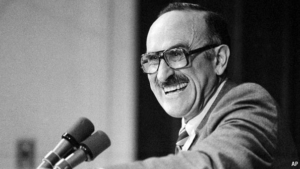
As Forbe’s put it (March 3, 2023), “Carter set up the phenomenal repudiation of stagflation, the great disinflationary boom of the 1980s and 1990s, that began soon after he left office. Carter was surely the greatest deregulator of any president, Reagan included.”
The Reagan Administration was much more business-friendly. Maybe too friendly. EPA enforcement was gutted, it goes without saying. But as an example of the pattern of showering well-connected business interests with whatever they asked for, it would be hard to top the Garn-St. Germain Act that “reformed” the Savings & Loan industry, aka the thrifts. Reagan pushed for this legislation, and signed it with more than a little gusto:
Thank you all very much, and thank you for joining us to sign this historic reform. This bill is the most important legislation for financial institutions in the last 50 years. It provides a long-term solution for troubled thrift institutions. It’s proconsumer, granting small savers greater access to loans, a higher return on their savings. And when combined with recent sharp declines in interest rates, it means help for housing, more jobs, and new growth for the economy. All in all, I think we hit the jackpot.
– Ronald Reagan, remarks.
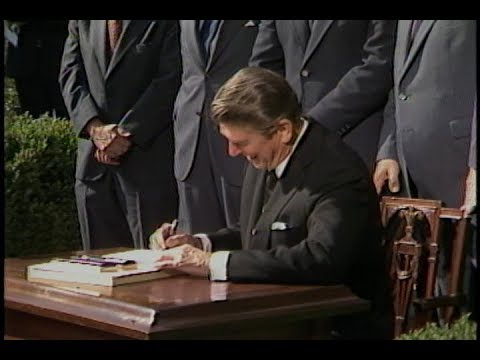
Someone certainly hit the jackpot.
The thrifts were designed to be boring. They took in small deposits, paid interest that was subject to a regulated ceiling, and insured those deposits with a federal backstop. In turn, they loaned money for residential homes, generally at a correspondingly low rate of interest.
During Volcker’s crushing of inflation, interest rates soared and the thrifts hemorrhaged depositors to higher-interest commercial banks. This was a real problem, although almost destined to solve itself when interest rates came back down again.
But Garn-St. Germain simply removed the ceiling on deposit interest, then allowed the thrifts to lend on just about anything they wanted. The Act also loosened accounting standards – yet retained the federal backstop.
This was too good to pass up, practically a license to print money. And what ensued was anything but boring: colorful, outrageous, and highly predictable. Some S&L’s grew at fantastic rates, paying unheard-of interest on deposits and piling into commercial real estate. New S&L’s popped up like mushrooms, especially in Florida, California, and Texas; owners paid themselves princely sums and ran their banks into the ground. Between recklessness, incompetence, insider self-dealing, and outright fraud, hundreds of thrifts went belly up, overwhelming the backstop, the FSLIC. The “S&L Crisis” led to the creation of the notorious Resolution Trust Corporation, which ended up disposing of over 700 insolvent thrifts.
Now, in the mid-1980s, the Dow stood at around 1,200. Today, it’s around 42,000. By that yardstick, the $125 billion that RTC cost the US taxpayer is equivalent to over $4 trillion in today’s economy. Undeniably, the thrift industry had its problems. But Garn-St. Germain was gasoline on the fire. Cozy regulatory forbearance fanned the flames, and the industry burned to the ground.
It would be interesting to look at other examples of Carter’s pig-headed insistence on taking unpopular action regardless of political consequences, like the Grain Embargo, cutting off the sale of American wheat and fertilizer to the Soviet Union after that country invaded Afghanistan, another politically disastrous move taken in an election year – and reversed by his successor to appease midwestern states. But this post is already too long.
When it was healthy, the thrift industry was boring. The down and dirty trade-offs between regulation and marketplace, to get the best of both, is boring. It’s much more fun to give things away.
But the business of government, done right, is work. And it’s apparently thankless work. And very often it does not get done at all, not without someone’s truly courageous leadership.
Make of that what you will.
James Earl Carter died December 29, 2024, aged 100. RIP




About The Author
